4 Essential Tips for First-Time Con-Goers

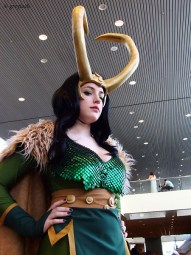
Baltimore Comic-Con Loki
Ditch the Costume

This article is by Joseph Zieja.

Cons are vicious, insane things, where emotions run as hard and fast as the alcohol, where dreams are made and broken at bars, and where George R. R. Martin sends people out for cheese steaks at three o’ clock in the morning.  You will meet people dressed in costumes from anime you have never heard of and, now, never want to see.  It’s a horrifically daunting, exhilarating, and generally rewarding experience.

So why should you take advice from me about going to a convention?  Because I’m you.  I’m the new guy, and I’m here to give you the new guy’s perspective on con-going, and I think I did pretty well for myself at the last few cons.  I’m here to give you the 4 Essential Tips of Convention Attendance.

Read more

Racial Diversity in Speculative Fiction

This article is by Anne Leonard.racial diversity

A current – and recurring – topic of conversation in the SFF writer/ blogger/ reader community is the lack of people of color (POC) writing and publishing in the field.  (This is also an issue in the literary community in general; here’s a recent post on the subject that appeared on the Book Riot website.)

People of color are underrepresented in SFF for a lot of reasons, but one which I see frequently mentioned is that books without diversity make POC feel excluded.  This creates a vicious circle – POC don’t read SFF, so they don’t write SFF, so there aren’t POC in SFF books, so POC don’t read SFF.  One way to break the cycle is for white writers to include more diversity in their own work.

Read more

The Why of Weapons: The Great Sword of War

This article is by Joseph Malik.

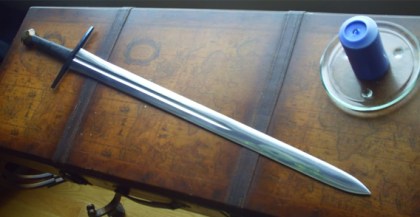
Today I’m going to discuss an underrepresented weapon in fantasy, although it was likely the single greatest casualty-producing weapon on the medieval battlefield until the development of the longbow.

Image 1A Gran Espée de Guerre by Michael “Tinker” Pearce. (www.tinkerswords.com)

It’s a sword. It’s arguably the sword. It’s the Oakeshott Type XIIIa great sword of war, referred to as a gran espée de guerre.

Read more

How to Kill Your Main Character

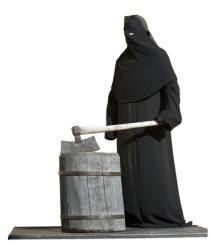
ExecutionerThis article is by Rhiannon Paille.

Catching Fire, the edgy, emotional, and jarring sequel to Suzanne Collin’s The Hunger Games trilogy pushed the boundaries, pitting teens against teens in a battle royale to the death, winner takes all. In light of the popular Suzanne Collin’s books, everyone is looking for a way to up the ante and do the unthinkable.

What’s more unthinkable than killing your main character?

As a young adult fantasy author who killed my main character in The Ferryman + The Flame series, I thought I’d give you some insight into the epic thought process that lead to the untimely death of Kaliel, The Amethyst Flame.

Read more

Fan Fiction: An Epiphany

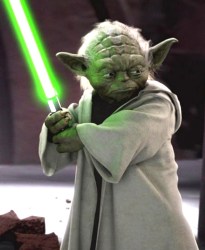
YodaThis article is by A.L.S. Vossler.

Fan fiction is the lowest life form of the writing universe.

If you had asked me what I thought about fan fiction about a year ago, that is what I would have said.

I had not always looked down so fiercely on fan fiction.  I was never a huge proponent of it, but I did not always thumb my nose at it, either.

In college, however, I took a creative writing class.  We talked about “developmental” stages of writing, and the most infantile of those stages was the “writer’s personal fantasy.”  The idea behind this stage was that the writer was living vicariously through the characters and only producing, more or less, self-indulgent tripe.

Read more

The Great Free Book Debate: The Authors

This is the second article in a two-part series by Alexandra Butcher. Part one is here.

One of the most controversial ways to promote a book is to offer it for free. The theory is that readers will take a chance on a free book by an unknown author, and that this will help the author to get her name “out there.”

Why is this controversial? Well, many authors feel offering one’s book for free devalues it, the author herself and thus all indie authors. It is also debatable whether this strategy actually works in a market already full of what some see as “substandard” books. There is also the argument that readers will madly download free books, and never actually spend any money on buying books.

So do authors really see any benefits?

Read more

J.R.R. Tolkien: Myths That Never Were and the Worlds That They Become

Ian McKellen as Gandalf

This article is by Dan Berger.

It’s strange to imagine today, but there was a time when the publication of J.R.R. Tolkien’s The Lord of the Rings was a matter very much in doubt.

There were two primary reasons for this near tragedy. One was the scarcity of paper that plagued the United Kingdom in the aftermath of World War II. The other was Tolkien’s initial insistence on releasing The Lord of the Rings to his publisher, Allen & Unwin, only on the condition that The Silmarilion be published in concert with it.

The price of printing the full text of a book the size of The Lord of the Rings posed significant challenges in and of itself; adding The Silmarilion to the mix, particularly given its sometimes tenuous connection to The Lord of the Rings’ narrative, was seen as potentially disastrous.

Read more

The Great Free Book Debate: The Readers

This is the first in a two-part series by Alexandra Butcher. Part two is here.

Indie authors are given an almost overwhelming amount of advice about promoting and marketing their book, a great deal of which is contradictory.

It has to be said there is NO single path to take which works for every author. One person may find a good deal of success with one way, and the next finds that it simply does not work.

One of the most controversial ways is to offer a book for free. Amazon’s KDP Select Programme allows self-published authors to do just this.  In return for exclusivity to Amazon, an author can offer his or her book for five days free promotion in every ninety day term. The theory being readers will take a chance on a free book by an unknown or little known author which they may not otherwise consider.

Read more