What Your Local Librarian Can Do for Authors

This article is by Jane Chirgwin.

librarianYou might already use libraries for books, movies and internet, but have you considered how your local librarian can help you as an author?

I’m a Library Director, so let me give you the inside scoop. (Side note: not everyone who works at a library is a librarian, just like not everyone who works at a hospital is a doctor.  Also not every librarian is female, I’m just using that pronoun.)
Read more

Channel Your Inner Samurai – How Being an Author is Like Performing Martial Arts

This article is by K.S. Crooks.

SamuraiI began my life-long journey with martial arts at the age of eight, when my mother enrolled me in my first judo class. Being a very small boy, she thought that it would give me strength and confidence. It gave me those, plus much more.
In high school I took up wrestling, becoming city champion and provincially ranked. During university I went back to Judo, started Jeet Kune Do and Karate. Martial arts became one of the staples of my life.

Read more

5 Steps to Effective Editing

This article is by Sydney A. Kneller.

glowing penOnce you’ve agonized your way through a story or novel, you breathe a sigh of relief that your task is finally done. But the truth is, the hard word is just beginning.

Before you can send your work out to be seen by the world, you need to spend some time editing. This is a crucial stage in the life of your manuscript, as this is when mediocre stories may rise to greatness.

Here are a few steps to use in the editing process:

Read more

Naming Your Characters – 4 Quick and Dirty Tips

This article is by Terrie Quincey.

namelessNaming your characters is often step one in the writing process. Don’t let it hold you back. Create names using these quick tips so you can move on with your story.
1. Consider Ancestry

This is a useful tool to get the ball rolling. Does your character have an ancestry in your mind? You can look up a list of names from that background and see if any seem like what you’re looking for.

If nothing else, this is a good way to narrow your options if you’re struggling. This can be true of characters that come from a distinct ethnic background.

Read more

Setting Stories in My Own Backyard

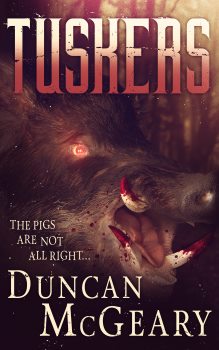
TuskersThis article is by Duncan McGeary.

I’ve never subscribed to the notion that one must “write about what you know.”

I mean, what do I know about a wild pig apocalypses?  Or vampires who evolve?  Or Donner Party werewolves?  Or Bigfoot and gold miners?

This stuff is spun out of my imagination, and even when I research, I like to have the basics correct while I allow my ingenuity to create the rest.

But I see no reason why I can’t set my stories in places I know, as much as possible.

Read more

The Power of Symbolism

symbolsThis article is by Jacob Gralnick.

How do you convey an entire idea, feeling, or characteristic without saying a word?

The same way you can foreshadow a future event in subtle passing, and you can do that with a little nifty thing called symbolism.

Used correctly, and at the right time, symbolism can add meaning and depth to your writing on the subconscious level and propel a simple passage to one that rivals bestseller and Hollywood quality scenes.

The best part: it’s as simple as whittling.

Read more

What Writers Can Learn From Soaping

This article is by A.L.S. Vossler.

dreamstime_xs_40257559Recently, I took up the hobby of soaping, which, as you might guess, is making soap. There are three ways of making soap: hand-milled, cold process, and hot process.

Hand-milled, which is also known as melt-and-pour, basically involves taking a soap base which someone else has already prepared, and modifying it by melting it, putting in your own additives such as colors and fragrances, and molding it. This process does not require working with lye. I’ve never actually tried this, because I prefer the idea of building my soap from the ground up, so to speak. If soaping were writing, melt-and-pour soap would be fan fiction.

Read more

Beta Readers: The Unsung Heroes of Literature

silhoutteThis article is by Julian Saheed.

There is a reason we all leave space for acknowledgments in the first few pages of our books.

Though our names appear on the front covers as the architects of the story, there are those who check to make sure the final product is what people want. Those whose eyes are red from reading, whose hands are tired from scribbling and whose contributions must never be taken lightly.

I speak of course of that most noble of vocations, the Beta Reader.

Read more