Or maybe have a child/nephew/cousin reading one of the touted best of the best in school? Something like Moby Dick or Ivanhoe, maybe even Pride and Prejudice or Wuthering Heights.
If so, have you heard them complain about being bogged down in description?
I recently reconnected with some old projects, and was a little upset when I read them.
One of the mistakes I’d made was incorrectly anticipating story length, and now it feels like those old stories, that I thought were done and buried, have risen from their graves to haunt me.
Not only did I take some too-big concepts and try to write them into short stories, but I’ve got a few longer works that should probably be trimmed dramatically, because my work is better and cleaner when I begin with a short story format.
While some novels seem so complex that one could hardly try to distill their concepts to a single sentence, others are easy to peg on the first try. What makes it so hard to nail down a concept? And once you have a concept, what length of story will tell it?
Ever wonder how armies of tens of thousands of men spring up from the ground overnight like weeds?
How these weedy men go clickity-clank across the landscape with few troubles?
Do you question the ability of a feudal society to maintain said massive weed crops which they throw willy-nilly to the wind against one another?
For me I think that actual weeds have the decency to drain the land of its resources. I do not see any gardening of any sort go on in many of today’s fantasy stories that involve large scale warfare. No one is watering these things, feeding them the nutrients they need to batter down the other bigger weeds in their way.
As a fantasy writer, you’re likely to create new and fascinating worlds for your stories to take place in. You have entirely new races, and their cultures and histories date back thousands of years.
You have gods and religions, dragons and monsters, heroes and villains. You have magic.
In short, you have a world.
Now it’s time to bring it to life.
Sure, the story is the important bit, but having your story take place in a living, breathing world just adds to the magic – and isn’t that part of the allure of reading and writing fantasy?
Do you spend weeks and weeks designing the ceremonial cloaks that your orcs wear for their Annual Wereboar BBQ?
Do you sketch maps of obscure villages that haven’t existed in your world for thousands of years on napkins?
Do you lie awake before bed and think, “I really should figure out how the ogres in Fazbaath take care of their teeth.”
If you even thought for a split second, “This sounds like me,” then you might be an Obsessive Worldbuilder.
Now let me start out by saying, this isn’t a bad thing. You have a certain eye for detail that some of us can only dream of having. However, it might be important to factor in the “Story-Worldbuilding Ratio.”
I have a confession to make. It’s probably not a big deal to anyone, except to me – specifically to me as a writer. So, here goes: I’m not a native English speaker.
I was born, and grew up, in Sweden. I learned Swedish first and didn’t start learning English in school until I was ten years old. Still, I choose to write in English, even though it’s not my native language and even though my grasp of it is weaker than my grasp of Swedish.
For as long as I can remember, I’ve always had ideas for stories. When I was young, many involved Gary-Sue-ing myself into my favorite TV shows and movies, as a security officer with Borg implants on ST:NG or as a cryogenically frozen Jedi from the Old Republic.
As I got older, my desire to explore my own universes grew. ‘Original’ ideas filled my head, and I believed I could tell a fun tale or two. Unfortunately, I thought stories only came from the magical places in my head called talent and creativity, and once tapped, the words would flow like a river. I expected the story to appear on the page complete and perfect and ready to publish. And when it didn’t, I felt like a failure and a fraud.
Ever notice how every race in a fantasy world must have a unique culture, history, and language?
It’s almost unheard of to not include each of these aspects in the genre. It’s become a convention fantasy readers have expected since the days of Tolkien. If you leave any of these out in your story, you’ll probably pay a heavy price in readership.
That’s why savvy fantasy authors include them. Not just to meet the conventions mind you, but also to create an engaging world.

 Have you read a classic novel recently?
 I recently reconnected with some old projects, and was a little upset when I read them.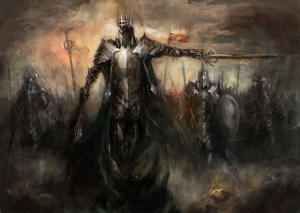
 Ever wonder how armies of tens of thousands of men spring up from the ground overnight like weeds?
 As a fantasy writer, you’re likely to create new and fascinating worlds for your stories to take place in. You have entirely new races, and their cultures and histories date back thousands of years.
 Do you spend weeks and weeks designing the ceremonial cloaks that your orcs wear for their Annual Wereboar BBQ?
 I have a confession to make. It’s probably not a big deal to anyone, except to me – specifically to me as a writer. So, here goes: I’m not a native English speaker.
 For as long as I can remember, I’ve always had ideas for stories. When I was young, many involved Gary-Sue-ing myself into my favorite TV shows and movies, as a security officer with Borg implants on ST:NG or as a cryogenically frozen Jedi from the Old Republic.
 Have you read an epic fantasy novel recently?